Let's talk about race!
Via feministe I found a link to a Bitch PhD post about white privilege. Bitch linked to a great article that I'll excerpt below. I really like how she talked about her efforts to explain white privilege to white people. It sometimes takes us white folk a long time to but aside our blinders. Here's Bitch:
A lot of that shit is invisible to most middle-class white kids--through no fault of their own--and when I used to tell those stories in some of the classes I taught, the white kids would start out saying, "oh, I'm sure that the teacher wasn't being racist, he just didn't hear you speaking Spanish but he heard the other kid"--until I said, "and what about this story? And this one? And this one?" And the students of color would say, "I was that brown kid, and the teachers *never* believed me," and then the white kids would say, "really? wow," and get kind of quiet and say, well, maybe yeah, after all. And then sometimes they'd start to see that there were things they just *did not know* that the brown kids did, and that not knowing was not their fault, but that nonetheless, it was a kind of ignorance, a kind of racism.
Like me, Bitch has a problem with "white guilt":
Now, I truly think that one of the best ways to get past that paralyzing and annoying and counter-productive guilt bullshit is just to learn to recognize onself as part of a larger whole; and, in my own education, learning to think past guilt (not, of course, always successfully) was probably one of the best things I ever learned how to do.
I'm not at all as charitable as Bitch is towards the experience of "white guilt". I think white guilt is a damn cop out. White guilt is just another method of making the white person the subject of the story. I all of sudden realize that I have been experiencing the benefits of a racist society, and my response is to continue to think about myself exclsuively. I now need to deal with my guilt, my mistakes, my ignorance. Boy I am awfully important aren't I. I'd better spend more time working on myself!
The point is to get over yourself and turn your attention to someone else for a change.
Here's the great article that Bitch referenced.
White Privilege: Unpacking the Invisible Knapsack by Peggy McIntosh
Daily effects of white privilege
I decided to try to work on myself at least by identifying some of the daily effects of white privilege in my life. I have chosen those conditions that I think in my case attach somewhat more to skin-color privilege than to class, religion, ethnic status, or geographic location, though of course all these other factors are intricately intertwined. As far as I can tell, my African American coworkers, friends, and acquaintances with whom I come into daily or frequent contact in this particular time, place and time of work cannot count on most of these conditions.
1. I can if I wish arrange to be in the company of people of my race most of the time.
2. I can avoid spending time with people whom I was trained to mistrust and who have learned to mistrust my kind or me.
3. If I should need to move, I can be pretty sure of renting or purchasing housing in an area which I can afford and in which I would want to live.
4. I can be pretty sure that my neighbors in such a location will be neutral or pleasant to me.
5. I can go shopping alone most of the time, pretty well assured that I will not be followed or harassed.
6. I can turn on the television or open to the front page of the paper and see people of my race widely represented.
7. When I am told about our national heritage or about "civilization," I am shown that people of my color made it what it is.
8. I can be sure that my children will be given curricular materials that testify to the existence of their race.
9. If I want to, I can be pretty sure of finding a publisher for this piece on white privilege.
10. I can be pretty sure of having my voice heard in a group in which I am the only member of my race.
11. I can be casual about whether or not to listen to another person's voice in a group in which s/he is the only member of his/her race.
12. I can go into a music shop and count on finding the music of my race represented, into a supermarket and find the staple foods which fit with my cultural traditions, into a hairdresser's shop and find someone who can cut my hair.
13. Whether I use checks, credit cards or cash, I can count on my skin color not to work against the appearance of financial reliability.
14. I can arrange to protect my children most of the time from people who might not like them.
15. I do not have to educate my children to be aware of systemic racism for their own daily physical protection.
16. I can be pretty sure that my children's teachers and employers will tolerate them if they fit school and workplace norms; my chief worries about them do not concern others' attitudes toward their race.
17. I can talk with my mouth full and not have people put this down to my color.
18. I can swear, or dress in second hand clothes, or not answer letters, without having people attribute these choices to the bad morals, the poverty or the illiteracy of my race.
19. I can speak in public to a powerful male group without putting my race on trial.
20. I can do well in a challenging situation without being called a credit to my race.
21. I am never asked to speak for all the people of my racial group.
22. I can remain oblivious of the language and customs of persons of color who constitute the world's majority without feeling in my culture any penalty for such oblivion.
23. I can criticize our government and talk about how much I fear its policies and behavior without being seen as a cultural outsider.
24. I can be pretty sure that if I ask to talk to the "person in charge", I will be facing a person of my race.
25. If a traffic cop pulls me over or if the IRS audits my tax return, I can be sure I haven't been singled out because of my race.
26. I can easily buy posters, post-cards, picture books, greeting cards, dolls, toys and children's magazines featuring people of my race.
27. I can go home from most meetings of organizations I belong to feeling somewhat tied in, rather than isolated, out-of-place, outnumbered, unheard, held at a distance or feared.
28. I can be pretty sure that an argument with a colleague of another race is more likely to jeopardize her/his chances for advancement than to jeopardize mine.
29. I can be pretty sure that if I argue for the promotion of a person of another race, or a program centering on race, this is not likely to cost me heavily within my present setting, even if my colleagues disagree with me.
30. If I declare there is a racial issue at hand, or there isn't a racial issue at hand, my race will lend me more credibility for either position than a person of color will have.
31. I can choose to ignore developments in minority writing and minority activist programs, or disparage them, or learn from them, but in any case, I can find ways to be more or less protected from negative consequences of any of these choices.
32. My culture gives me little fear about ignoring the perspectives and powers of people of other races.
33. I am not made acutely aware that my shape, bearing or body odor will be taken as a reflection on my race.
34. I can worry about racism without being seen as self-interested or self-seeking.
35. I can take a job with an affirmative action employer without having my co-workers on the job suspect that I got it because of my race.
36. If my day, week or year is going badly, I need not ask of each negative episode or situation whether it had racial overtones.
37. I can be pretty sure of finding people who would be willing to talk with me and advise me about my next steps, professionally.
38. I can think over many options, social, political, imaginative or professional, without asking whether a person of my race would be accepted or allowed to do what I want to do.
39. I can be late to a meeting without having the lateness reflect on my race.
40. I can choose public accommodation without fearing that people of my race cannot get in or will be mistreated in the places I have chosen.
41. I can be sure that if I need legal or medical help, my race will not work against me.
42. I can arrange my activities so that I will never have to experience feelings of rejection owing to my race.
43. If I have low credibility as a leader I can be sure that my race is not the problem.
44. I can easily find academic courses and institutions which give attention only to people of my race.
45. I can expect figurative language and imagery in all of the arts to testify to experiences of my race.
46. I can chose blemish cover or bandages in "flesh" color and have them more or less match my skin.
47. I can travel alone or with my spouse without expecting embarrassment or hostility in those who deal with us.
48. I have no difficulty finding neighborhoods where people approve of our household.
49. My children are given texts and classes which implicitly support our kind of family unit and do not turn them against my choice of domestic partnership.
50. I will feel welcomed and "normal" in the usual walks of public life, institutional and social.
Saturday, May 28, 2005
Friday, May 27, 2005
Blog oddity
Many months ago I wandered into a blog called The Underview. Several times I have wanted to comment on posts there or send comments directly to the person writing the posts.
BUT, when I click on any link on that website, I get moved to a random portion of the blog. I cannot contact the writer, I cannot comment at all. If anyone out there has a clue as to what is going on, I'd appreciate an explanation. It feels as if I've encountered some kind of internet curse.
Label me baffeled.
Thursday, May 26, 2005
Ravenhub met with Sami today. It's good to know he is safe and sound. He says the only people who support the occupation are the puppets who are getting paid by the U.S. government. Otherwise, the people are doing what they can. He told Ravenhub, "The Iraqis have a saying: 'When the horses are gone, you saddle up the dogs.' "
So an occupation government is a dog, not a horse. And still, you make do with what you have.
The thing that drives me crazy is that almost any ordinary American could and would do more to help the Iraqi people and one week than the bureacrats have done in months. Send some real construction workers over there and see what amazing accomplishments you'll find. Send American doctors and nurses over there and watch miracles occur. Send your neighborhood teacher, social worker or frelling babysitter, and see what can be accomplished. Instead, the Iraqi people are dealing with the sheisters and carpet baggers who couldn't make a living here, so they went to Iraq to make a "killing" on the Iraqi reparations shenanigans.
Tuesday, May 24, 2005
Report back from Iraq
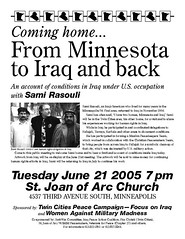
Sami is currently working for an Iraqi human rights group and has been to many of the areas affected by the war.
Monday, May 23, 2005
I just watched the movie, Guerilla: The Taking of Patty Hearst on PBS. I was profoundly affected by the entire Patty Hearst incident, but in ways that aren't normally talked about. I was a senior in high school when she was kidnapped, seeing my friends getting killed or warped by their experiences in Vietnam. Two years into the story, I was a journalist and waited with baited breath for the two-part story that Rolling Stone did about William and Emily Harris and Patty Hearst hiding out in Pennsylvania. I was in southeast Ohio at the time and everything seemed so close and immediate.
The webiste that PBS set up is hilarious. You can find it here. I'm thinking if the SLA had ever had the kind of production values PBS put into their little web sitelet, they might have won a few advertising awards!
I took their little "What's your bag" quiz and here's the result:
Authoritative Activist
You continue to speak out for what you believe is right, as part of a left-wing social justice organization. You've found a life partner who is a kindred spirit. The whole Nixon debacle affirms that the political system is corrupt, and you find yourself saying, "I told you so" to all those who doubted your earlier criticisms. Maybe now that Vietnam is in the past, the country can evolve -- you are committed to working for change through peaceful means. The Sixties might be dead, but the spirit of activism keeps on truckin' in the Seventies.
Well, that's only because the answers I wanted to provide weren't available, of course.
If you watch the film, I recommend you also listen to an interivew Terry Gross did with the film maker and a journalist who covered the story. It is available here. It does a good job of explaining how the timing of the Hearst kidnapping made all the difference. It was the first time journalists were able to report from the scene. They camped out in front of the Hearst mansion and competed with each other for coverage of the distraught family. The shoot-out in L.A. was the first life coverage of such an event. The media was so as much a part of the story as anything the activists or the authorities attempted in the whole affair.
I hope to write more about this soon.
Wednesday, May 18, 2005
I've been doing lots of reading lately. Good mysteries.
I just read Denise Hamilton's Sugar Skull (2003). I read Hamilton's The Jasmine Trade a year or so ago. Hamilton's main character, Eve Diamond, is a journalist who investigates interesting aspects of life in Los Angeles. The Jasmine Trade was about children of rich Asians who are sent to the U.S. for high school. The parents never actually live in L.A., they just pretend they live there so their kids are eligible for school. The kids are set up with maid and housekeepers, but are basically left to fend for themselves. This leads to chaos, of course, and Hamilton does a good job of describing a world unlike any I'd known.
"Sugar Skull" is about Latino music culture in Los Angeles and also about rich kids who get off on hanging out with homeless kids in urban hell holes. Again, Eve Diamond gets involved in a world unlike any I've known. What I like best about these novels, of course, is that everything has to do with class. In the U.S. we pretend there are no classes, and yet when we scratch below the surface, we run up against the consequences of class.
Hamilton has two other books, Last Lullaby and Savage Garden that I'll add to my list of what to get next.
Next up, I read three books by Charlaine Harris. I'd already read several Lily Bard books based in Shakespeare, Alabama. Bard is a fascinating woman whose life was transformed by a brutal kidnapping and gang rape. She survives, but in the process she murders her abductor and becomes a media celebrity. The pretty obvious subtext in these books is about how a survivor's live is affected and how one goes about re-establishing trust and healthy relationships after such a brutal event. Bard is a cleaning lady, which allows her to become intimately acquainted with her neighbors and also helps her to solve the rather-too-common murders that occur in her neighborhood. Shakespeare is like Sunnydale, CA, from Buffy, the Vampire Slayer -- you have to accept that nobody seems to notice that horrible things seem to happen in this small town and people still choose to live there.
This past week, I read Shakespeare's Trollop and Shakespeare's Counselor. The writing is sure and involving. I don't want to stop reading and I always am left with the "and then what?" feeling when I'm forced to put the book down. Bard is a woman worthy of respect, but also deeply flawed in a way that's easy to relate to. I look forward to reading more.
What was surprising, however, is that Harris has branched into the vampire world with her Sookie Stackhouse series. I read the first book, Dead Until Dark. We meet Sookie, a working-class waitress in a small-town bar. Vampires have just come "out of the coffin" with the explanation that their condition is actually the result of a virus and therefore a medical problem (ala alcoholism), rather than being actually undead. So learning about real-life vampires has a sort of voyeuristic appeal and fascination. Sookie, of course, ends up with her very own vampire lover who is the archtypical broody man of mystery. I'll definitely read some more of these books. Harris's vampire books are pitched as Anita Blake-light. I tried to hang onto Laurel K. Hamilton's Anita Blake vampire series but got really tired of reading the same book over and over again. In that light, Stackhouse is a fun and enjoyable alternative.
At the moment I am reading The Librarian by Larry Beinhart. It's about a presidential campaign against a strikingly familiar spoiled rich boy who grows up to be president. So far, it's hilarious and interesting. I'll write more once I've finished reading.
Friday, May 13, 2005
Pinko Commie Cosmonaut!
Well, this proves it!
| You scored as Communism.
What Political Party Do Your Beliefs Put You In? created with QuizFarm.com |
Thursday, May 12, 2005
mother's day march
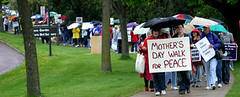
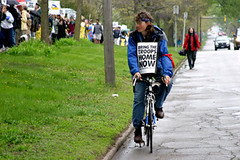
My job for these events is to create the flyers (see below). Once I get to the event, my job is to do several crowd counts. This is not only to keep track of our own activities, but also to have some honest numbers for the press. Local news organizations got into big trouble for underestimating crowds several years ago and ever since then we've been building the reputation for honest reports on turnouts for our events. In the second picture, that red-draped figure in the background is me, after performing the third crowd count of the day. I was on my way to the front of the march so that I could do a count of people entering the church. As it turned out, there was only one reporter at the event. I called and spoke to her a couple of hours after the march and gave her my numbers. She agreed to the wording "over 250 participants" after I gave her all four counts.
Wednesday, May 11, 2005
Additions to the blogroll.
Today I've added one of my favorite blogs, Wood's Lot, to my blogroll. I've been reading this blog for several years. Every day there is at least one link that inspires and teaches me something. Yesterday there was a link to a Michelle Cliff article about reclaiming forgotten history. Fascinating story about the lies we tell ourselves about the past. Here is an excerpt:
How do we capture the history that remains only to be imagined? That which has gone to bush, lies under the sea, is buried in the vacant lots of big cities.
In my mind I erect a scaffolding; I attempt to describe what has not been described. I try to build a story on the most delicate of remains.
I traverse the American landscape as someone foreign-born, as a writer, a novelist, as a woman who has fallen in love with this country—certain that this love demands accountability. This love impels my search into America’s past.
Wood's Lot contains links to art, poetry, fiction and philosophy. Sometimes the subjects are way beyond my comprehension. Often I learn about painters, photographers and poets I've never known before. Often I am reminded of writers that have influenced me greatly (Joy Harjo, Michelle Cliff, etc.) and I find wonderful links to articles I haven't read before.
The second addition to my blogroll is Sappho's Breathing. The webmistress is a graduate student teacher of feminist moral philosophy. Lately I've been reading through her archives and coming upon topic after topic of interest.
Catching up now.
Last Saturday was the Mother's Day March for Peace. About 275 people showed up on a warm rainy day. There were songs and a reading of Juliet Ward Howe's Mother's Day proclamation at the Peace Garden, then a march over to a church for a snacks and a program. The program was terrific -- all women and all reflecting on the war and its effects. The first speaker, a teacher, spoke about the affect of the "No Child Left Behind" act and the lack of funding for schools. The second speaker has a son in Iraq and talked about war and its effects on her family. The last speaker was a state senator who immigrated from Laos and talked about war as it affected her own life. All were fantastic.
I got a call to work at the bookstore Saturday afternoon -- from 4 to 8. I picked up a stack of Andrea Dworkin books to reread.
Sunday we drove down to Mom's to enjoy a Mother's Day brunch together.
Yesterday I went to a program on Wal-Mart and its effects on workers and neighborhoods. One of the neighborhood activist was an architect whose viewpoint was from how buildings impact on a community. He spoke of the troubles the Midway neighborhood had trying to make sure the big box stores moving in had windows, lights, etc. They had to fight to encourage them to face the street with foot traffic and transit stops. The big boxes, born on freeway exits, still orient themselves toward the freeways, despite moving into urban areas that have different realities.
Today I'm catching up on chores and reading.
Friday, May 06, 2005
Baby owlet

I get an inordinate amount of enjoyment by watching live bird cams. Our local energy conglomerate has a slew of them at this site including nests for owls, eagles, osprey and several peregrine falcons. They are all roosting on eggs or taking care of babies this time of year. The owlets are just plain silly looking and make me laugh whenever I happen to get a good look at their faces!
Thursday, May 05, 2005
Yesterday, I met with Craig Cox to pick up several copies of his book Storefront Revolution for the bookstore. His book is about the "co-op wars" in Minneapolis that happened just a few years before I became politically active here in the late 70s and early 80s. Co-ops are still around and still struggling, and people are curious to know more about the history.
After work I went over to the U of M to join in a student-organized protest against the new plan to phase out General College. Nine protesters were arrested after sitting in at the President's office. The issue is about class, pure and simple. General College is the only access that people from the community have to the University. The U wants to attract top research scientists from around the world, which is a worthy goal. But they've decided they must cut off access from the local community in order to do it.
Tonight, I went to St. Paul to hear Liza Featherstone talk about her book, Selling Women Short: The Landmark Battle for Women's Rights at Wal-Mart" at Macalester College in St. Paul. The author is not a gifted public speaker, but the book, of which I've read the first few chapters, is quite good. She's onto something with her analysis of consumer culture and what happens in a world where citizens are turned into consumers. More on this issue once I've finished reading the book.
I just finished reading A Walk in the Woods: Rediscovering America on the Appalachian Trail by Bill Bryson. I picked it up at my last book group meeting. It is a quick read and quite hilarious. Bryson decided to walk the Appalachian Trail one summer and his account of the event is hilarious. Not a champion athlete, he managed to plow through several hundred miles through sheer stubborness. In fact, the successful trail walkers seem to embody a combination of sheer grit and lunacy that would be out of place anywhere else in the world. I lived on the edge of the Appalachians when I went to college at Ohio University and I vaguely remember fantasizing about walking the Appalachian Trail. After reading the book, I recognize that the trail is a symbol of something purely American and wonderful -- the urge to appreciate nature, the willingness to help strangers, the code of the trail. With so little community left in this world, it is a joy to read about it in Bryson's book.
------
Yesterday, May 4, was the 35th anniversary of the Kent State massacre. I lived in Ohio in 1974 and the memory of that day was still alive at that time. In this day of cynicism, it is hard to understand how much that day affected people my age. We didn't realize just how callous our politicians had become. We didn't understand the depths to which Richard Nixon and his cronies would stoop to gratify their personal ambitions. Those soldiers who opened fire on their fellow citizens had been convinced by Gov. Rhodes, the mayor of Kent and the president of the University, that the innocent students they were firing at were evil infiltrators bent on destroying their way of life. Why did Rhodes and his gang stir up such hatred? Purely for their own personal political gain. They won, too, in the short term. But our country lost so much that day. I can't experience May 4 without feeling that draw -- that memory of betrayal and profound sadness.
And speaking of sadness, I am still profoundly affected by the death of Andrea Dworkin. 20 years ago I spent my life working day and night against violence against women. I understood then that there was a war against women in this world. The women in combat -- those on the front lines -- were living in a war unlike any we have glorified in our combined social conscience. The front line was the home -- the battle was between individual men and women. The personal is the political and once you are touched by that truth, there is no going back.
What Dworkin was then and will continue to be is an anchor for the rest of us. The horror of what happens to individual women at the hands of individual men in this country is sometimes incredibly hard to bear. But Dworkin bore it and refused to back away. She was our standard-bearer. She stood out front and suffered the slings and arrows -- the lies and distortion -- and never flinched. It made it easier for the rest of us, knowing that she was there, standing up for all of us. I want and I need to write more about this amazing woman.
In time. In time.
Tuesday, May 03, 2005
Ravenhub had me ROTFLMAO Saturday morning as he pretended to be a cable news reporter following the story of the "missing" woman who turned out to be a runaway bride. It had just been learned that she had not been kidnapped, there had been no danger or crime -- she just needed to get away -- and apparently VEGAS was the proper place (oi vey!)! As Ravenhub so aptly put it, the prestitutes went on and on about how "betrayed" they were. "I feel so used!" Ravenhub whined. "I've been violated!" he added. Yeah, right, you fuckheads!
In a totally unsurprising web meme, I discover that I am not a Republican:
-12% Republican. | "The Marxists are too reactionary for you. With people like you around, America collectively thanks God for John Ashcroft." |
I'm finally recovering from a busy weekend. Saturday I had a meeting of my book group, followed by my shift at the bookstore. Sunday was the annual Mayday Parade. This event is sponsored by In the Heart of the Beast Puppet Theater and involves large puppets, a parade made up of community members and lots of fun. From the web site:
The 31st annual MayDay Parade and Festival will be Sunday, May 1, 2005 beginning at 1:00 p.m.
HOBT's MayDay Parade and Festival is eagerly anticipated by thousands who flock to the parade route and ceremony site to join this joyous spring ritual. For many, this is the highlight of the year, as they donate countless volunteer hours needed to bring beautiful and fantastic puppets and floats to life.
The 31st annual MayDay Parade and Festival will be Sunday, May 1, 2005 beginning at 1:00 p.m. HOBT's MayDay Parade and Festival is eagerly anticipated by thousands who flock to the parade route and ceremony site to join this joyous spring ritual. For many, this is the highlight of the year, as they donate countless volunteer hours needed to bring beautiful and fantastic puppets and floats to life. Click here to see this year's MayDay Park Entertainment Schedule.
Held on the first Sunday in May, MayDay is a testament to COMMUNITY. Immense joy is generated as thousands of people work towards a common, energetic purpose.
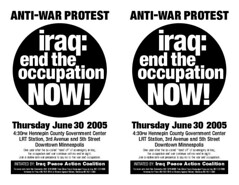
After the puppets, various community organizations, etc., there is the Free Speech Zone in which politics can raise its ugly head. This year I marched with Women Against Military Madness and handed out the flyers I made for an anti-war protest on June 30. The weather was typical Minnesota "spring" weather: include snow, sleet, patches of sunlight, winds and rain. By the end of the day I was tired, but happy.
For dinner we went out to Stillwater where my uncle and aunt provided dinner. My mom was staying over, after flying back home from visiting my bros in California. A wonderful evening with family and friends.
Friday, April 29, 2005
05_06-30-05_Iraq
Thursday, April 28, 2005
You Know You're From Minnesota When... |
The weather is usually 80% of your conversation. When you say "down south" you're referring to Iowa. You call highways "freeways." Snow tires came standard on your car. You've never taken public transportation. 75% of your graduating high school class went to the University of Minnesota. "Perkins" was the only hangout option in high school. You assume when you say "The Cities" people know where you're talking about. You can list all the "-dales." People from other states love to hear you say words with "o"s in them. In a conversation you've heard someone say "yah sure, you betcha" and you didn't laugh. You could pinpoint exactly where each scene in the movie "Untamed Heart" was filmed. You hate the movie "Fargo" but realize you and your entire family have that same accent. You get mad at people who think Fargo is in Minnesota. You know what Mille Lacs is and how to spell it. You have fish boiled in lye for Christmas. You know what "uff-da" means and how to use it properly. You know the 2 sports-related reasons why we hate Dallas. Nothing gets you madder than seeing a Green Bay sticker on a MN car. The only reason you go to Wisconsin is to get fireworks. You're a loyal Target shopper. You've frozen your tongue on a metal handrail before. You own an ice house, a snowmobile, and a 4 wheel drive vehicle. You wear shorts when it's 50 degrees outside in March, but you bundle up and complain in August when it goes below 60. You have gone trick-or-treating in 3 feet of snow. You've not only walked across a lake, you've driven across one. Everyone you know has a cabin or, at least, access to one. You know that Lake Wobegon isn't real and you know who made it up, where they live, and exactly what you want to do about it. You have friends who schedule their wedding in the middle of January without a thought about weather conditions. You consider a six inch snowfall a blessing for "the cities" because it provides instant urban renewal. You keep the snow tires on your truck all year because it ain't worth taking them off for only two months. Your local Dairy Queen is closed from December through February. You believe the only REAL vehicles have skis in front and a loud motor under your seat. You consider snow banks to be "just another rough" on the golf course. You have worn shorts and a parka at the same time. You were delighted to get a miniature snow shovel for your 3rd birthday. Your town isn't trying to be ironic when it plans a "winter carnival." The temperature in March is above freezing for three days in a row, and you think it's summer. You laugh out loud every time you see a news report about a blizzard shutting down the entire East Coast. You think happiness is owning a "piece of lakeshore." You never meet any celebrities except The "BODY" You know what and where "Dinkytown" is. When you talk about "opener" you are not talking about cans. You have refused to buy something because it's too "spendy." You believe that the Vikings would have won four Super Bowls by now if they were still playing in Metropolitan Stadium. You are convinced the Twins will never win the pennant because the owners are too cheap to pay the good players, so they all leave. Your town has an equal number of bars and churches. You grew up thinking rice was only for dessert. You think that ketchup is a little too spicy. Your gas station thinks "full service" means filling your gas tank, washing the windshield, checking the oil and being friendly to the customers. You (or your parents) voted for Mondale. You've seen "The Rocky Horror Picture Show" in Uptown. You know that everyone has a city preference -- Minneapolis or St. Paul. You can honestly claim Germanic / Scandinavian ancestors, and have been known to say "ya" instead of "yes" Upon seeing an ocean for the first time, you say, "Hey! That looks like Lake Superior!" You actually get these jokes and pass them on to other friends from Minnesota. |
05_06-30-05_Iraq
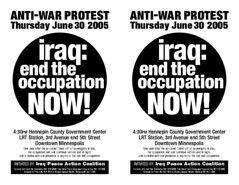
The Iraq: end the occupation NOW! is a type treatment on a button I found on the web. Maybe I can make larger signs as well.
Enjoy!
Monday, April 25, 2005
Oy vey! This is where the intellectual mafia hangs out and tries to meet each other: The London Review of Books personals:
Example:
Woman, 43, would like to meet a man – any man – whose evolutionary path isn’t that of Homer Simpson. Suspecting that’s too difficult, I may go lesbian. Box no. 08/10
Bi-zarre! I love to challenge my mind and will subject myself to more extreme levels of intellectual hair splitting than most people I know. But there are times when I can clearly see the vast gulf between my life and the life of an academic intellectual! :)
On the other hand, I have greater respect for those who can skillfully executive various crafts: including skillful operation of a machine lathe, skillful manipulation of a bandsaw, and/or skillful execution of graphic design through digital means. Which brings me to a great series of events in St. Paul.
The St. Paul Public Library's series: Untold Stories is a free program celebrating Labor History Month. Unfortunately, there doesn't seem to be a calendar of events on-line. I have a printed copy that I will retype if I can't find a decent link. The first event is Thursday, May 5, so there's time.
On a sad note, I went to a memorial service for a local activist who recently died of breast cancer. Damn, that makes me angry. She was good people. The service was distinctly odd: focusing only on a portion of her life and neglecting to encompass the entire life of goodness and activism that was Mary. It was very strange. I am quite sure she's raising a ruckus wherever she is today.
For sheer joy of life, I copy here, for those without access to the L.A. Times, a great
story about a street poet:
April 21, 2005
COLUMN ONE
Happy to Feed 'Em a Line
Whether reading for old ladies or young radicals, poet Colin McIlvoy keeps the meter running on the streets of San Francisco.
By John M. Glionna, Times Staff Writer
SAN FRANCISCO — Old ladies prefer love poems. They stand frozen on the sidewalk staring into space as though listening to faraway music, letting Colin McIlvoy's spoken imagery wash over them like whispered compliments.
To a 60ish woman wearing a purple hat, he reads the Margaret Atwood charmer "Variations on the Word Love":
… This word is far too short for us, it has only four letters, too sparse to fill those deep bare vacuums between the stars that press on us with their deafness.
The woman announces that her knees are weak.
"Read it again," she says. "Once is not enough."
McIlvoy knows his audience. He knows that mothers and daughters like nature themes and will wait quietly through a five-stanza walk in the woods. He knows young radicals want shock treatment, outlaw verse with hip-hop immediacy. Hammer me, they say, with a bruising blow. Or an insult.
And McIlvoy complies. On days off from a community organizing job, the 20-year-old New Mexico native packs a dozen dog-eared tomes into an oblong red toolbox and takes to the street. He assumes a spot in a middle-class neighborhood called West Portal Village, just over the hill but a world away from counterculture Haight-Ashbury, where poets and philosophers rule the roost.
Outside a Charles Schwab brokerage office, he posts a sign announcing that all his offerings are free. Then he patiently solicits passersby to disengage from their cellphones and big-city routines and appreciate an all-but-forgotten public art form.
"Like to hear a poem?" he asks. "It's not a very long poem."
People pass as though hypnotized, their eyes downcast, shoulders tense. A few make eye contact, but most shake their heads.
"You sure?" he says to a dog-walker. "How can you turn down free poetry?"
"No time," the man says.
"I'm very, very busy," says a woman in a stoplight-red jacket.
One person in 10 stops, like the lady with a leopard-skin purse who pauses for Pablo Neruda's "Ode to My Socks."
As McIlvoy reads, he looks up to catch the woman's eye, sharing a private moment on a public street, before resubmerging into the ocean of words:
The moral of my ode is this: beauty is twice beauty and what is good is doubly good when it is a matter of two socks made of wool in winter.
"That's lovely," she says.
The troubadour sees opportunity. "Want to hear another?"
She hesitates. "Why are you doing this?"
"No one reads poetry anymore," he responds. "I want people to have poetry in their day. It's a hobby. People build model airplanes. I read poems."
He writes them as well. But McIlvoy — who calls himself Mack — never reads his own work. Instead, on an average day, he'll read 40 poems by contemporary stylists such as John Updike, Billy Collins, Rebecca Bagget and Heather McHugh.
McIlvoy is no poetry jukebox. He reads poems he likes. Sometimes he'll even offer to feed a listener's parking meter to win a few more moments. He takes the occasional request, like from the woman who asks: "Hey, you got something to do with wisdom? I need a wisdom fix."
There's no artistic pretense to McIlvoy's poetry performances — no pseudo-beatnik berets or bohemian dress. He drives a decidedly un-hip white Oldsmobile with Illinois plates his grandmother willed him. He wears Oxford shirts, and his hair is cut schoolboy short. Many people assume he's a missionary.
Sometimes, the poet hits his mark — as he does with the woman who rushes past mumbling before wheeling about to hear two poems.
"I can't believe I just said 'No' to a poem," confesses Cecelia Wambach. The college math teacher is leaving for Prague and is crazy with final details. But how can anyone, she asks, be too hectic for a quiet moment?
"We run the globe with glazed eyes but don't have time for each other," she says. "I almost walked past a free poem. But I want to change. This is a start."
------------------------------------------------------------------------
McIlvoy has a strict rule for the 100 poems in his street-reading repertoire. He likes them short, never abstract. Funny or sad, they must hit home instantly, like breaking news.
The son of a novelist father and a psychologist mother, McIlvoy began making up poems before he could spell. He winces over how poetry is taught in school, where works chosen for analysis are too often dense and make most teens view poetry as they would Latin: as a dead language.
After studying architecture at the California College of the Arts in San Francisco, he canvassed in 2004 for presidential candidate John F. Kerry. For months, he went door to door asking for campaign contributions. He stood on street corners and hit up passersby. All the while, he read verse to fellow campaign workers.
"I have this bad habit," McIlvoy says. "If I'm around my friends long enough, they all know that eventually they're going to hear a poem."
------------------------------------------------------------------------
His curbside readings began last November, when he read bursts of verse to friends canvassing for an environmental cause in West Portal. He also stopped a few strangers and found he liked engaging people with poetry. Canvassing made him practiced in the art of the sell, prompting a name for his endeavor: the poetry canvass.
The poetry reader has taken his verse across San Francisco. In pricey Pacific Heights, he's knocked on doors, saying, "My name is Mack. I don't represent any group, and I don't want your money. I just want to read you a poem, and then I'll go."
He has also read poems in Bayview Hunters Point, the city's poorest neighborhood — once approaching five youths throwing dice on a staircase. From "The Outlaw Bible of American Poetry," he read "I Am the Bomb" by Mike M. Mollett:
I am most wise.
I play for keeps.
I am the unimaginable.
I have not been created for nothing.
When he finished, McIlvoy recalls, nobody said anything. The poet turned to leave.
"That's cool," one kid said, not looking up. "Read another."
McIlvoy follows a long tradition of believers spreading the word on poetry. Experts know what he's up against.
"Poetry is the poor little match girl of the arts, but at least that girl was selling something useful: a match that can light a cigar," says Billy Collins, a two-time poet laureate of the United States. "But what do you do with a poem? It's useless. That's why some people love it and some people scratch their heads: Why do they need it?"
Collins has pushed to publish verse on buses and subways and persuaded an airline to briefly feature an in-flight poetry channel: "To read poetry is to join the community of human feelers, because a guy writing an Italian Renaissance poem felt exactly what you feel when a girl leaves you."
Yet even a poet laureate sees limits for the art form's mass appeal. "Lots of cool things have small audiences," he says. "Like jazz and collecting tropical fish."
Still, Collins applauds McIlvoy's guerrilla tactics. "He's ambushing people, and I'm all for that: poetry coming out of unexpected places. I like the way he apprehends people. Like a stickup man."
------------------------------------------------------------------------
McIlvoy performs in a culture with too little privacy, where solicitors hassle people at home and on the street. Some see his act as just more public noise.
He describes how, when he approached a couple, a woman snapped: "Can't you see we're here talking to people we really want to be talking to!"
Another woman climbed into her BMW and observed: "You know, this really isn't working out for you. You need to get a life."
Others welcome the intrusion. Liz Burnham, 42, who works three jobs yet describes herself as an "anti-establishment slacker who walks on the beach and does a lot of yoga," recites for McIlvoy one of her own works: a heroin-related riff on a nursery rhyme she calls "Mary Had a Little Smack."
Then she adds sheepishly: "That was a bit too punk, huh?"
McIlvoy meets people with too little time — and too much. A homeless man with unruly blond hair heckles him regularly. "He hated the poem I read him," McIlvoy says. "He insists that I should be reading Shakespeare."
A college theater major complained that his readings showed too little passion. Still in the thrall of a McIlvoy love poem, a woman returned with a valentine. When a streetcar passed, drowning out a poem, George Shoblo wanted to hear it again.
"I've always got time for a poem, that's just me," says the 63-year-old hairdresser. "God gives you unique little experiences. It's as simple as that."
McIlvoy is still learning to read his audience. As he was reciting nature verse to a 9-year-old girl and her mother, he said, the child pointed to a John Updike work called "Dog's Death."
McIlvoy advised against the poem, saying it dealt with sadness and loss. "You won't like it," he said.
The girl insisted. So McIlvoy read — he and the mother finally fighting back tears.
In the car to the vet's, on my lap, she tried
To bite my hand and died.
I stroked her warm fur
And my wife called in a voice imperious with tears.
Though surrounded by love that would have upheld her,
Nevertheless she sank and, stiffening, disappeared.
McIlvoy said that when he was through, the girl looked at him and sighed. She said she loved the poem.
Thursday, April 21, 2005
